
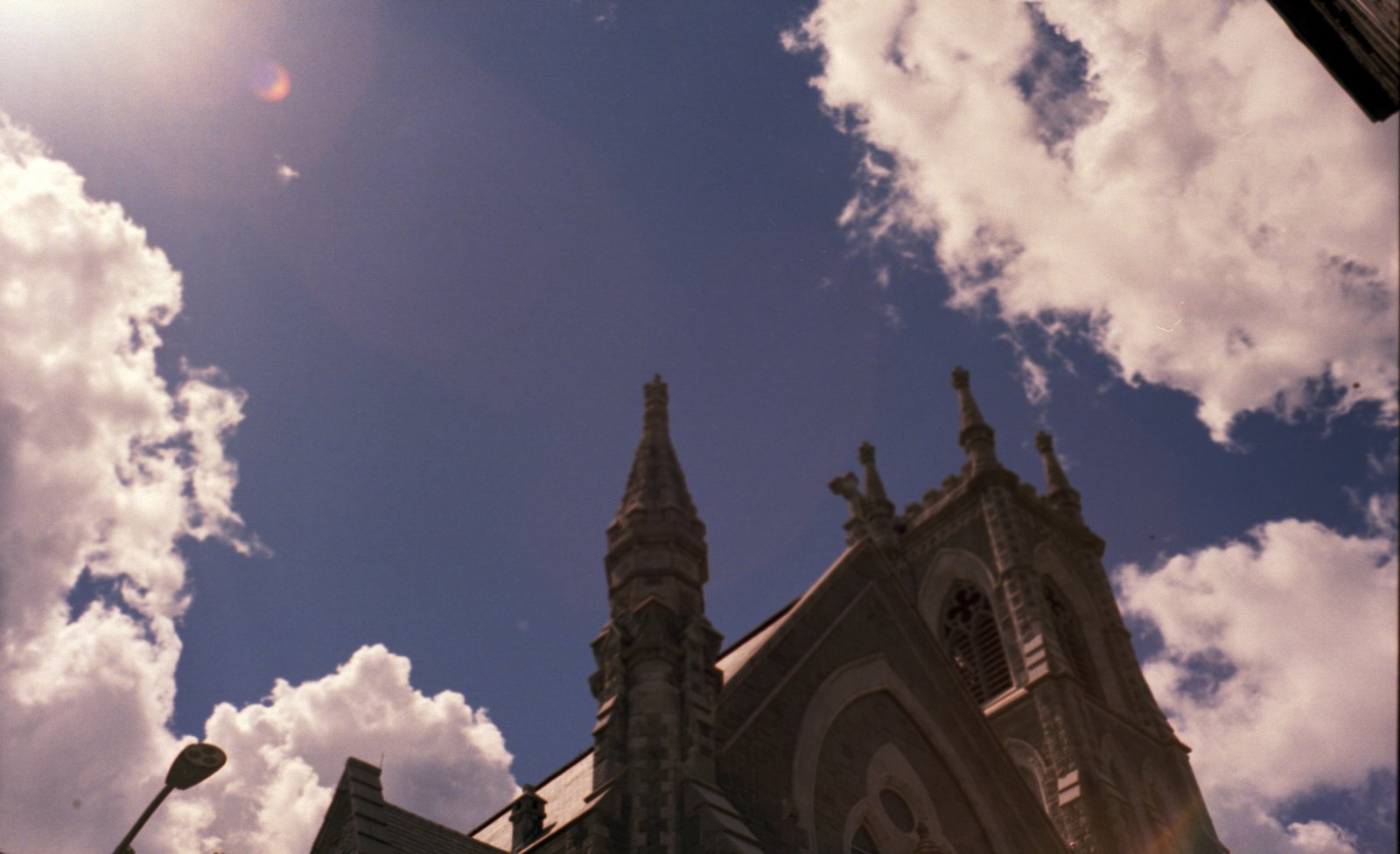
A case for photographing the lamp posts, fountains, and gargoyles our cities stopped making.
Walk through the older part of almost any city and look up. Above the chain-store signage and the traffic cameras, you'll find another city: carved faces peering from cornices, iron vines curling up lamp standards, bronze lions spitting water into stone basins. Then walk to the newer part of town and look up again. You'll see galvanized steel poles, LED fixtures shaped like shoeboxes, and glass curtain walls that reflect the sky but say nothing of their own.
This isn't just nostalgia. Something measurable has changed in how we build public space. The street furniture of the nineteenth and early twentieth centuries was designed to be looked at. Today's is designed to be procured, installed, maintained, and eventually replaced from a catalog.
For those of us who shoot film, that shift should matter. The ornamental city is slowly disappearing, and the slow, deliberate way we photograph is well suited to recording what's left.
The Lamp Post: From Sculpture to Specification
The ornamental cast-iron lamp post was a small civic sculpture. Foundries produced elaborate bases with fluted columns, acanthus leaves, dolphins, and city crests. Gas lamps and early electric lights were mounted in lanterns with finials and scrollwork. Each city had its own patterns, and many neighborhoods did too.
Over the mid-twentieth century, that changed. Roads widened for cars, lighting standards were written around uniform illumination levels, and the cobra-head streetlight became the default across much of the world. Later came safety requirements such as breakaway poles along roadways, then the switch to LED heads designed mostly for efficiency and easy maintenance.
None of these decisions was foolish. Modern streetlights are cheaper, brighter, safer, and use far less energy. But no one designed them to be beautiful. They are a specification, not a statement.
Shooting it: An old lamp post is a vertical subject with fine detail, which makes it a natural portrait-orientation frame. Shoot the base at close range in low, raking light early or late in the day, when the relief casts shadows. For the whole post against the sky, a yellow or orange filter on black-and-white film will darken the blue and make the ironwork stand out.
The Fountain: Water as a Public Gift
Public drinking fountains were once both infrastructure and art. The best-known example is Paris's Wallace fountains, donated in the 1870s by the English philanthropist Richard Wallace. Their cast-iron caryatids hold up a small dome over the water, and more than a century later many are still in use and still painted the same dark green.
Cities in Europe and America built temperance fountains, horse troughs with carved lion heads, and memorial fountains paid for by local benefactors. Clean water in public was a civic gift, and it was dressed up to look the part.
Today's public water is more likely to come from a stainless-steel bottle-filling station bolted to a wall, if it's offered at all. It works well, but it isn't meant for anyone to linger at.
Shooting it: Fountains let you use shutter speed as a creative control. At 1/500 the water freezes into beads and threads. At half a second on a tripod it turns into silk. A 3-stop ND filter makes slow speeds possible in daylight with a medium-speed film. Bracket more than usual, because the highlights on wet stone and moving water can blow out quickly on slide film.
The Gargoyle: Architecture With a Sense of Humor
Strictly speaking, a gargoyle is a waterspout. It is a carved channel that throws rainwater clear of the wall. The carved figures that don't carry water are grotesques. Either way, they are among the most human things architecture ever produced: medieval stone carvers put monsters, drunkards, animals, and sometimes caricatures of each other up on cathedral rooflines, where almost no one would see them up close.
The tradition kept going longer than people think. American Gothic Revival buildings, university campuses, and even Art Deco towers carried it forward. The steel eagle heads on the Chrysler Building are gargoyles for the machine age.
Then the Modernist movement took hold. Adolf Loos's essay Ornament and Crime argued that decoration was wasteful and backward, and the International Style that followed stripped buildings down to structure, glass, and proportion. Postwar construction economics sped things up. Today, carved stone is rare and expensive, and the building's "face" is often a rendered panel system chosen from a manufacturer's range.
Shooting it: Gargoyles are high and far away, which brings two problems: converging verticals and a lack of reach. A large or medium format camera with rise or tilt movements, or a shift lens on 35mm, keeps the building upright. A short telephoto, around 135mm on 35mm or 250mm on a 6x7, fills the frame with a single face. Overcast days are underrated here, since soft light brings out weathering and lichen without harsh shadows cutting across the carving.
Why Everything Became Utilitarian
Blaming modern designers for this would be easy, but the real reasons are mostly practical:
The first is cost. Skilled carving and pattern-making for decorative castings are labor-heavy, while standardized parts are cheap and quick to replace. The second is liability and regulation: safety codes, accessibility rules, and road standards all favor tested, uniform products. The third is procurement: public agencies often buy from catalogs through competitive bidding, which rewards the lowest compliant bid rather than the most distinctive design. The fourth is maintenance: an ornate fixture that breaks needs a custom replacement, while a standard one comes back from the warehouse. The last is taste: a century of Modernism taught planners and architects to see ornament as clutter.
The result is what some critics call placelessness. Street by street, a new neighborhood in Boston can look almost identical to one in Phoenix or Manchester. The things that once told you exactly where you were have been replaced with things that could be anywhere.
Film Photographers Have Done This Before
There is a long tradition of photographers documenting a city just before it changes, and much of it was done with film and large cameras.
Eugène Atget spent roughly three decades photographing old Paris with a view camera and glass plates: shop fronts, doorknockers, courtyards, fountains, and stair railings. Much of it was being cleared away during that time. His images now form one of the most important records of a city in transition.
Berenice Abbott, who helped preserve Atget's work, did the same for New York in the 1930s with her Changing New York project, photographing the old city as skyscrapers rose around it.
Later, Bernd and Hilla Becher took a different approach. They photographed water towers, blast furnaces, and gas tanks in precise, evenly lit, frontal views and arranged them in grids. Their work shows that even utilitarian objects can reveal variety and character when you look closely and consistently. That idea cuts both ways: the old cobra-head streetlights that replaced ornate lamp posts are now vanishing too, and someone should probably photograph them.
A Project Worth Starting
If you're looking for a long-term project, the vanishing ornament of your own city is a good one. A few ways to approach it:
- Build a typology. Photograph every surviving ornamental lamp post in your town in the same way: same lens, same framing, same light conditions. Present them as a grid.
- Pair old and new. Shoot an ornate fixture and its modern replacement from matching angles, and show them side by side.
- Follow one street. Revisit a single block every season and record what gets removed, restored, or replaced.
- Go small. Doorknockers, manhole covers, boot scrapers, iron fence finials, and carved keystones disappear quietly, one renovation at a time.
- Visit the archives. Many historical societies have old photographs of your streets. Stand where the photographer stood and shoot the same view today.
Why Film?
You can do all of this digitally, of course. But film brings the right pace to the subject. The people who made these objects worked slowly, by hand, over months or years. Photographing them with a camera that makes you meter, focus, and think before each frame feels like meeting that care halfway.
A well-processed black-and-white negative also has a practical advantage: it's a stable archival record that doesn't depend on file formats or storage devices. Atget's glass plates are more than a hundred years old and are still being printed.
The Last Word
Cities are still building things. Some neighborhoods are restoring historic lighting, commissioning public art, and asking designers for street furniture with a sense of place. Ornament hasn't disappeared completely; it has become the exception instead of the rule.
Until that changes, the carved faces and iron vines are still up there, weathering a little more each year. Load a roll, walk the old part of town, and look up.
Have you photographed ornamental details in your city? Share your work with the community and tell us where you found them.