






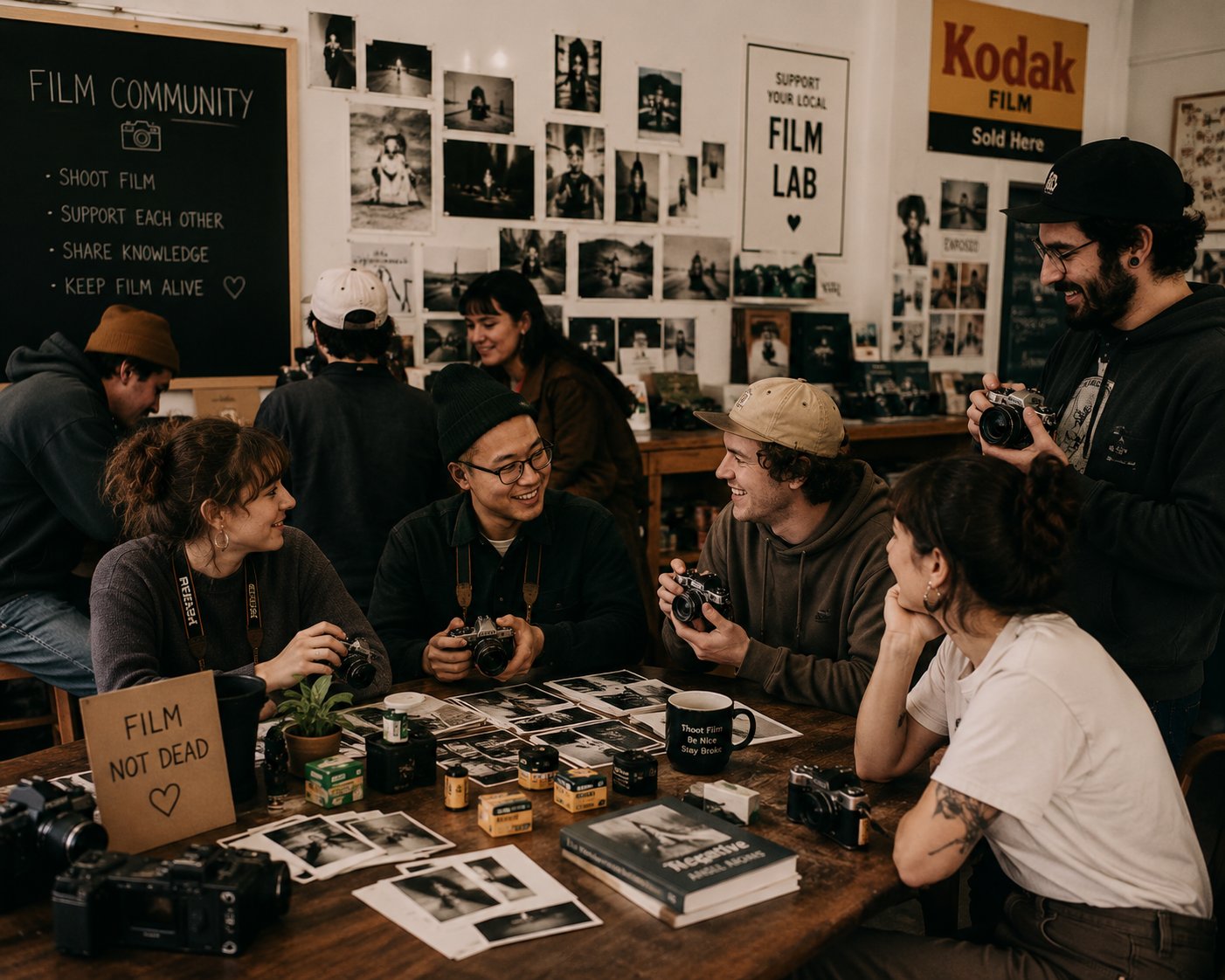
Film photography is one of the few crafts where you can do everything right and still not know it for two weeks. You meter carefully, you nail focus, you compose with intention — and then the roll sits in your bag, gets dropped at a lab or loaded onto a developing reel, and only later do you find out whether the magic happened or whether you fogged the whole thing loading it in the wrong light. That gap between action and feedback is exactly why a film community isn't a nice-to-have when you're learning. It's the difference between guessing for years and improving in months.
Digital photographers learn through instant repetition. You shoot, you check the screen, you adjust, you shoot again. Film strips that loop away. The feedback that the LCD used to give you has to come from somewhere else — and historically, it came from other people. The shop owner who told you your shutter was sticking. The darkroom regular who looked at your contact sheet and said "you're underexposing your shadows." The friend who'd already burned a box of paper figuring out the thing you're stuck on. That knowledge transfer is what a community is, and film has always depended on it more than most hobbies.
Film rewards shared knowledge more than almost any craft
Think about everything that sits between pressing the shutter and holding a print. Film stock and its quirks. Exposure latitude. Reciprocity failure on long exposures. Developer choice, dilution, temperature, and agitation. Fixing, washing, drying. Scanning or printing. Each of those is a place to go wrong, and most of them fail silently — you won't get an error message, you'll get a flat negative or a roll of blank frames and no obvious reason why.
You can read about every one of these. But reading "agitate gently" and having someone show you what gentle actually looks like are different educations. A good film photography community compresses the learning curve because someone has already made the mistake you're about to make, and they remember how much it stung. When you can ask a real question and get a real answer from someone who's developed a thousand rolls, you skip the expensive part of the lesson.
That's the core argument for joining one: film is a craft of accumulated, hard-won, often unwritten knowledge, and communities are how that knowledge moves.
Where do you actually ask the questions?
Every film shooter hits the same wall early on. You have a specific, weird, situation-dependent question — Why are my Portra scans coming back so green? Is this light leak from the back door seal or am I fogging during loading? My HP5 looks muddy, is it the developer or my metering? — and there's no manual entry for it because the answer depends on your gear, your process, and what you actually did.
This is where having a place to ask matters more than any book. A living community gives you somewhere to post the actual frame, describe the actual process, and get diagnosis from people who've seen that exact failure. The good ones develop a culture of patient, specific answers rather than "just shoot digital." When you're learning film photography, the ability to ask a question and trust the answer is worth more than another tutorial.
If you've ever tried to get a straight answer in a comment section, you already know the value of a space built specifically for this. That's a big part of what a dedicated film community offers that a general photography forum doesn't: everyone there has chosen the slow, deliberate, chemically-real path on purpose, so the conversation starts from shared assumptions instead of defending the medium.
Gear is communal whether you plan it that way or not
Film gear has a way of circulating. Cameras get passed down, traded, rescued from estate sales, and sold off when someone consolidates a kit. Almost nobody buys their whole setup new from one place — they assemble it over time, often from other people in the community.
This is one of the most practical reasons to plug in. A trustworthy network of buyers and sellers is how you find a clean body at a fair price instead of rolling the dice on a faceless listing. It's how you offload the lens you stopped reaching for to someone who'll actually use it. It's how you find a part for a camera that hasn't been manufactured in forty years. A community with active classifieds turns "I wish I could find one" into "someone two states over has one and wants it gone."
The same goes for the services side. Not everyone develops at home, and even people who do still need a lab for color, for E-6, or for the rolls that matter. Knowing which lab, from people who've actually used them, saves you from shipping precious frames to a place you found through a search ad. A solid film lab and business directory is essentially crowdsourced trust — the collective memory of who does good work.
Community is also how you stay motivated
There's a softer reason that's no less real. Film is slow, occasionally frustrating, and not always cheap. The roll you were excited about can come back as a lesson instead of a portfolio. Plenty of people drift away from it not because they stopped loving it, but because they hit a discouraging stretch alone.
A community changes the emotional math. Other people's work in your feed pulls you back out to shoot. A "nice frame" from someone whose eye you respect lands differently than a stranger's like. Watching a beginner you answered a question for start posting genuinely good negatives is its own quiet reward. Crafts survive in groups. The lone-genius story is mostly a myth — most photographers who stuck with film did it surrounded by other people who also stuck with it.
What to look for when you join a film community
Not every group is worth your time, so here's what separates the ones that actually help:
- A real question-and-answer culture. Look for threads where beginners get patient, specific answers rather than gatekeeping. The tone of how people treat newcomers tells you everything.
- Activity across the whole craft — shooting, developing, scanning, printing, and gear — not just camera-collecting or pixel-peeping scans.
- A way to buy, sell, and trade with people you can build a reputation with, so a transaction isn't a leap of faith.
- Trustworthy pointers to labs and services, because at some point you'll need a developer, a repair tech, or a lab, and a recommendation beats a gamble.
- A mix of experience levels. A room of only experts is intimidating; a room of only beginners is the blind leading the blind. You want both, talking to each other.
The bottom line
You can learn film photography alone. People do. But it's the slow, expensive, sometimes lonely way, and a lot of capable photographers quit before they get good because nobody was there to tell them the negative wasn't ruined — they just metered wrong, and here's the fix.
A film community gives you the one thing the medium can't give you by itself: fast, human feedback from people who've already walked the path. Somewhere to ask the weird question. Somewhere to find the right camera and unload the wrong one. Somewhere to be reminded, when a roll disappoints you, that the next one might be the best you've ever shot.
If you've been shooting film on your own and feeling the limits of that, the move is simple: find your people, start asking questions, and let the craft open up the way it's supposed to.