

Rapa Nui is roughly 63 square miles in size, a soft triangle, approximately 14 miles on its longest side from southwest to northeast, another 10 miles along the other two sides from northeast to northwest, and northwest to southwest. Its nearest inhabited neighbor is Pitcairn Island roughly 1200 miles to the west where the mutinied crew of the HMS Bounty found refuge. Its nearest uninhabited neighbor is Motu Motiro Hiva, a tiny migratory bird nesting islet some 240 miles to the northeast. Rapa Nui is also approximately 2400 miles due west of Chile, and 1600 miles east of Mangareva in the Gambier Island group, where evolving science indicates may be the origin for the Marquesan mariners who first discovered and inhabited the island around 1200 AD.
Three hundred or so years later, around 1550, the rain stopped falling on Rapa Nui.
Scientific research indicates that there was a severe and prolonged drought condition on Rapa Nui starting at that time, resulting in a 24-31-inch drop in average annual rainfall compared to the prior 300 years. The drought lasted for more than a century.
The impact of that dramatic environmental change, and the critical adaptive response that it necessitated from the Rapanui, reflects a human resilience and an ability to survive even in the harshest of environmental conditions and remains inspirational and hopeful for humanity to this day.
The long-held and enticing cautionary tale of ecocide, of an exploding population that destroyed their island's ecosystem and caused their own demise, apparently never occurred.
Still evolving scientific research is revealing that Rapa Nui never held much more than a sustainable population of about 3000. That was the population that existed on the tiny isolated, subtropic, semi-arid island when the first Europeans arrived in 1722.
The famous monolithic moai for which Rapa Nui is known, were primarily quarried and carved in Rano Raraku, a volcanic tuff cone near the northeast end of the island. The moai were carved and later "walked" to installation sites by clan work groups from their separate working locations within the crater.
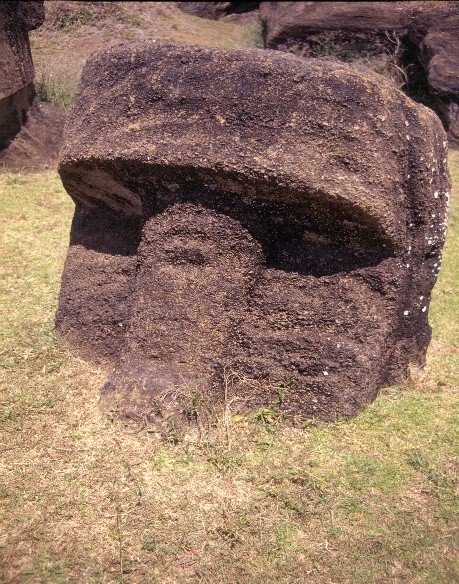
Recent scientific research also indicates that the locations of ahu platforms and moai around the coast appears to be consistent with the locations of fresh water sources.
The arrival of the severe, long-lasting drought on Rapa Nui, coincided with a societal shift away from decentralized clan leadership and moai construction toward a system of leadership based on earned merit connected to the Springtime Tangata Manu (Birdman) competition and its focus on Rano Kau crater and its fresh water lake at the southwestern tip of the island.
After more than 500 years in isolation, Dutch navigator Jacob Roggeveen came across the island in 1722. Spaniard Don Philippe Gonzales arrived from Peru in 1770, and British explorer Captain James Cook followed in 1774. Sporadic visits by other outsiders continued well into the nineteenth century, most notably by whalers, whose "recruiting" of islanders, willingly or otherwise, was a precursor of what was to come.
On December 8, 1862, eight Peruvian slave ships arrived off Rapa Nui. Once ashore, they first enticed the islanders with trade goods, then the armed slavers proceeded to abduct more than 1400 Rapanui, close to half of the population, including the religious and clan leadership.
Most of the abducted Rapanui died during their servitude on plantations in Peru either by contracting tuberculosis, by the harsh working conditions, or by other causes. Of the 100 or so Rapanui that were finally to be repatriated to their island after public outrage, 85 of those returnees died enroute, while some of those reaching home at last, carried Smallpox back to Rapa Nui.
In 1866 Catholic missionaries arrived. A year later a tuberculosis epidemic killed 300 of the remaining Rapanui. The next year Frenchman Jean-Baptiste Onésime Dutrou-Bornier arrived.
The impact of Dutrou-Bornier, backed by British firm Maison-Brander in Tahiti, was devastating to the Rapanui. By the time he was finally killed by islanders in 1876, the Rapanui population on the island had dwindled to a little over 100 individuals.
In 1888, Rapanui leadership and Chilean representation signed The Agreement of Wills in Hanga Roa. The agreement was viewed as forming a protectorate status by Rapanui, while viewed as a formal accession by the Chilean government. The repercussions of that event are still being felt to this day.
I knew almost none of these and other things about Rapa Nui when I arrived on island in 1998. I landed at Mataveri Airport aboard LanChile airlines during their twice weekly roundtrip stopover enroute to Santiago and then back to Papeete. I held a ticket for the return flight back to Papeete departing in three precious days.
Along with my camera, remaining film and a Ziploc bag filled with oatmeal cookies from my sister-in-law, I also carried a valuable hand-drawn map of the island given me by archaeologist Toru Hayashi along with his recommendation on how best to fill my three days on the island.
Prior to arriving, I had spent the last two weeks in Tahiti, at Maeva Village on the island of Huahine, providing voluntary labor at Dr. Yoshiko Sinoto's archaeological dig. It was by his encouragement and advice, and that of Toru Hayashi and fellow archaeologist Elaine Jordane, that I was making the journey to Rapa Nui at last.
With my Honeywell Pentax Spotmatic 35mm SLR camera with its 1:1.4, 50mm Super Takumar lens, a skylight filter, extra battery, a half-dozen rolls of Kodak Elite chrome 100, 36 exposure color transparency film, I landed at Hanga Roa on a cool and brisk mid-morning in late September 1998.
Cecilia Rapu Haoa, younger sister of archaeologist and former Rapa Nui governor Sergio Rapu, was waiting as I disembarked. She smiled. I was here at last.
Day one, 9/29/1998
I slept too well and got up at 9am. "It's cold today but not uncomfortable" I wrote in my journal. In the front room Momma Reina Haoa smiles and directs me to a table set for two. She leaves and comes back with sliced, peeled Kiwi fruit on a small plate, another with fresh-baked pound cake, biscuit and cups of butter and orange marmalade, and a large glass of orange juice, a coffee mug, a small pot of hot cream and a thermos of hot water with packets of coffee and Nescafe.
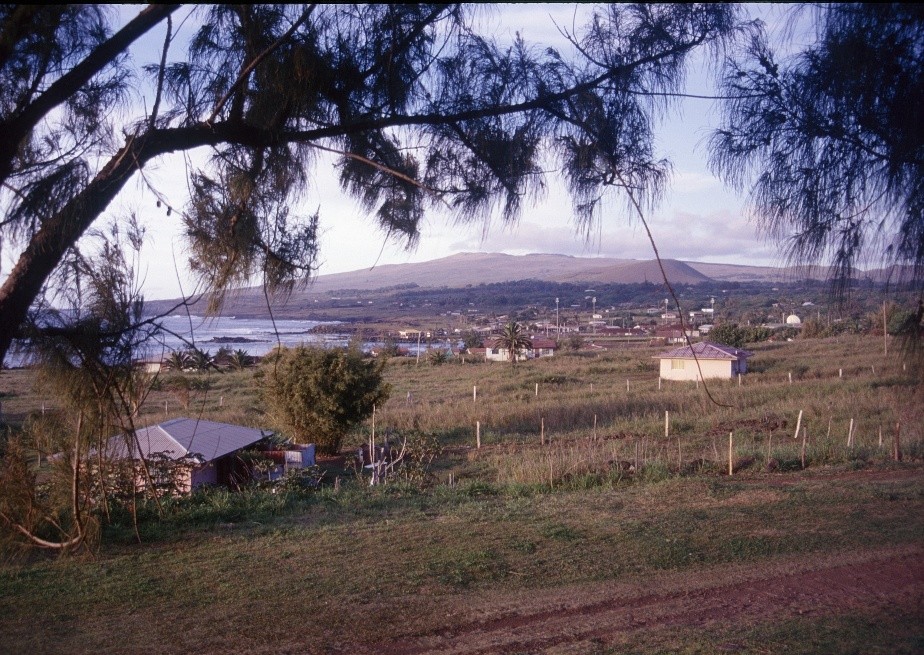
Outside it is blue sky and blustery. There is no sign of Cecilia or her brother Sergio. I had hoped to join Sergio on any tours he had planned with the American Elderhostel group staying at the other inn, Niko's. Otherwise, I planned to walk up the hill to Orongo on my own.
I wrote, "Heading out, down the road toward the airport, passing a yard filled with sawn logs and stone and wood carvings. I can hear rhythmic tap-tapping as I pass by. I recognize the sound, not mallet to chisel, but adze, traditional Polynesian. It must be the master carver that Toru mentioned. Maybe I'll have time to visit later."
I reached Ana Kai Tangata cave by mid-morning. "It is located just below Orongo, a sea cave of sharply layered, flaking basalt that appears to be continuously collapsing, providing large smooth areas of flat stone where birdman images have been drawn. They are drawn with whitish outlines, portions of heads, bodies and wings. The cave walls are filled with them. The ocean pounds against the rocks just outside the cave and dark clouds are building off shore."
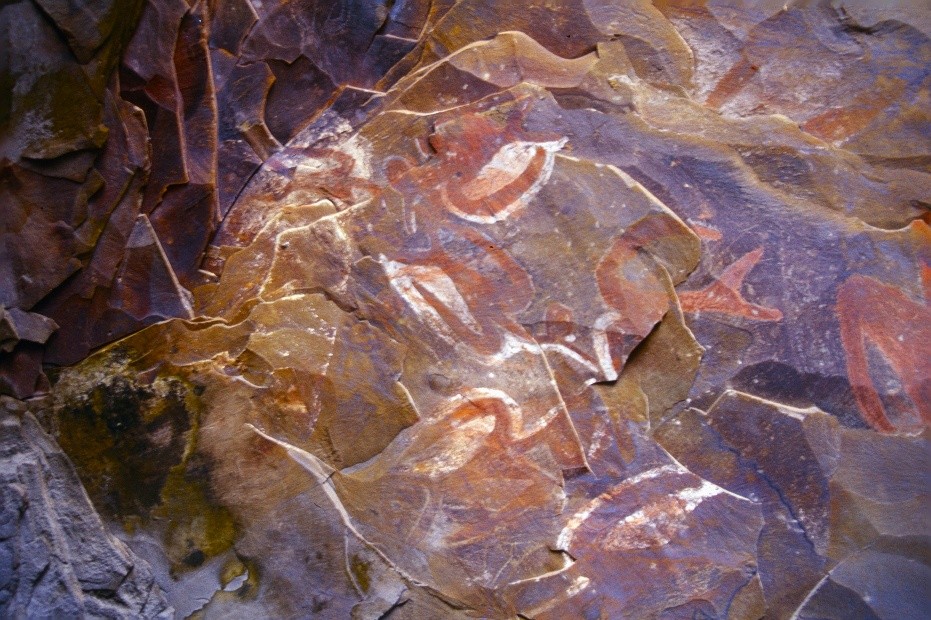
Continuing toward Orongo, I enjoy the cool breeze, the warmth of the late morning sun and feel the uphill grade beginning to make me sweat. I pass cautiously to one side of a small herd of cows lingering in the path and notice what looks like beer bottle glass in the red dirt. Looking closer, I realize it is shards of precious jet-black obsidian.
"After resting by the roadside for a while under a sweet-smelling, purple-flowering tree, I continue upslope through a dense forest. Turning, looking back down toward Hanga Roa, I wonder if the peak that is visible in the far distance might be Rano Raraku, site of the moai quarry. The thought of walking there, now seems unrealistic though still inviting."
It is Primavera, Cecilia had told me, the beginning of Spring. In the old days the Tangata Manu would be decided. The Birdman competition would take place after the arrival of the Manu Tara the Sooty Tern, arriving by the countless thousands to nest on Motu Nui, one of three islets just off shore from the southwest headland at Rano Kau. The other two islets are Kaokao, a sea stack, followed by Iti, with Motu Nui farthest offshore.
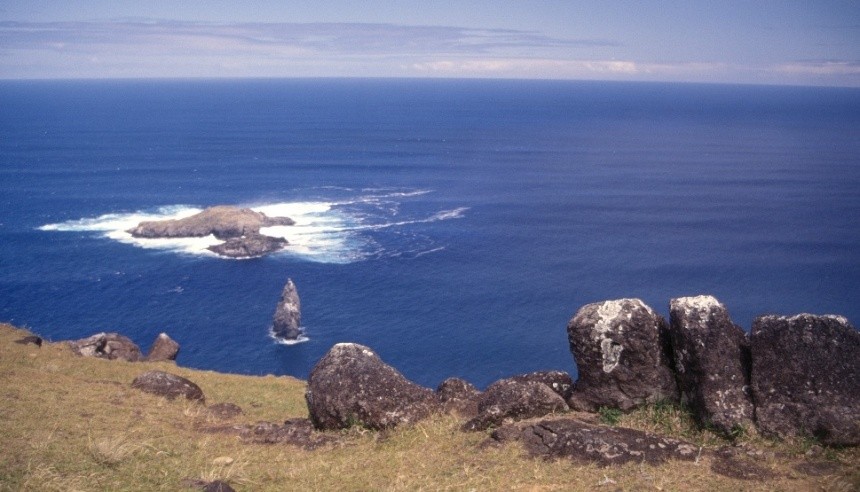
According to oral traditions, each Spring as Manu Tara (Sooty Terns) arrive on Motu Nui. Young men from each clan climb down the sea cliff, swim out to the islet and compete to find and bring back the first egg of the season. The Tangata Manu (Bird Man) is determined accordingly.
Manu Tara no longer arrive at Rapa Nui in the numbers they once did. A remnant population breeds and nests on isolated, uninhabited Motu Motiro Hiva 240 miles further east.
After climbing up the red dirt path to Orongo, I arrived at a small, rusted iron gate hanging down and open in the middle of a low stone wall. There, I stop dead, staring in amazement into the heart of Rano Kau crater. Far down inside the vertical crater walls the windswept blue Pacific sky reflects up like mercury among pads of reed and marsh grass from the freshwater lake.
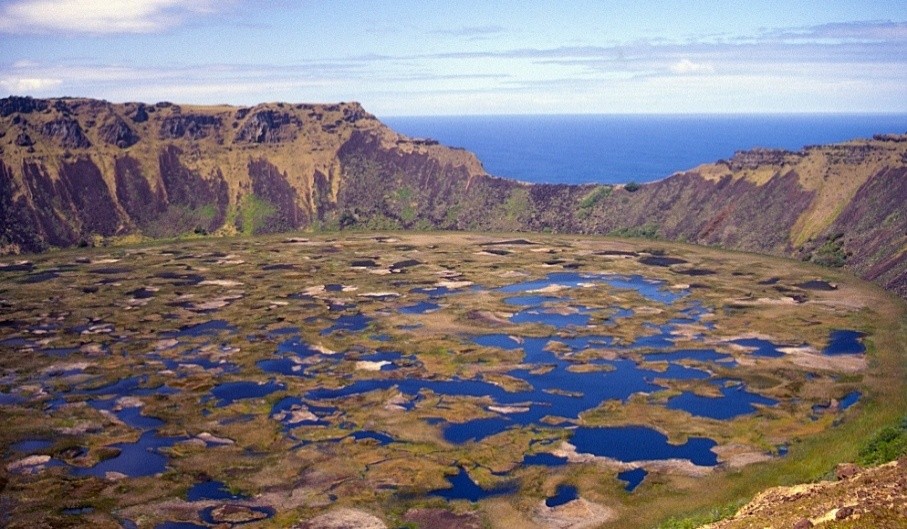
I follow the path along the rim of Rano Kau and come upon an ancient umu, an earth oven, lying cold and unused beyond the entrances of stone shelters.
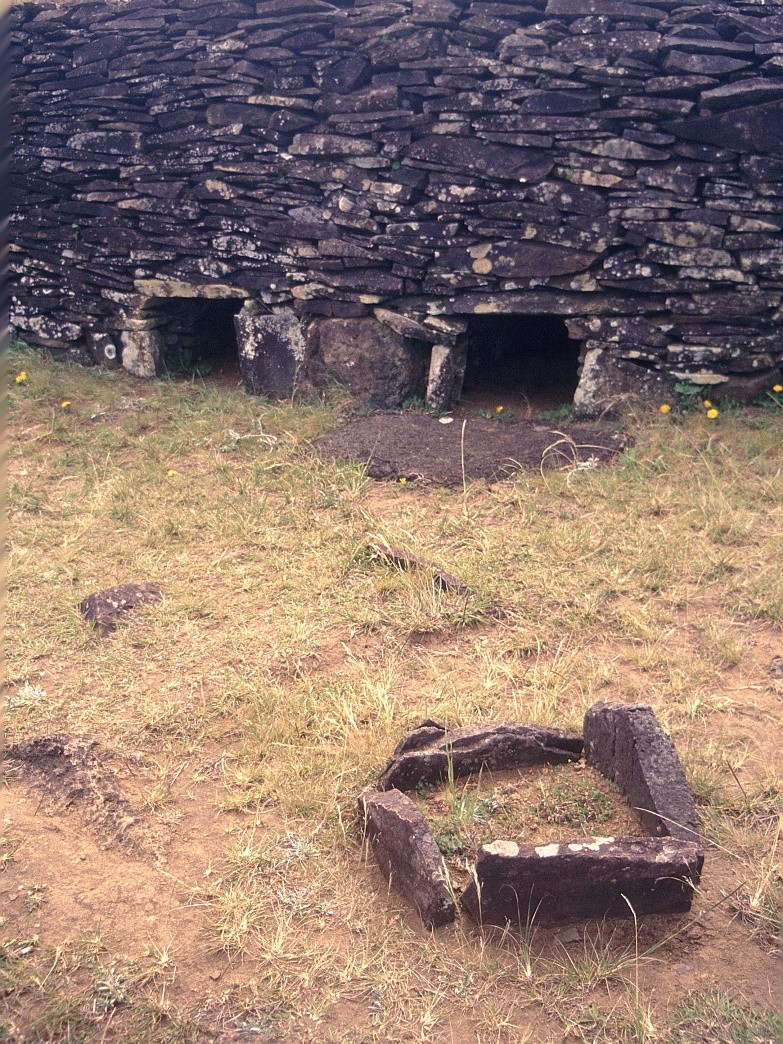
Constructed from keho, the flat shards of Rano Kau's volcanic rubble, the walls are layered to shoulder height, then cantilevered inward and covered over with dirt and grasses.
Each shelter has a small crawl-on-your-belly entryway into a dark windowless interior. The shelters are clustered together along two lower and upper rows leading to Mata Ngarau.
At Mata Ngarau, there are hundreds of incised images of Makemake, the Creator, Komari, symbol of fertility, and Tangata Manu, the Birdman, sometimes holding the egg of a Manu Tavake (Frigate Bird) or Manu Tara (Sooty Tern).
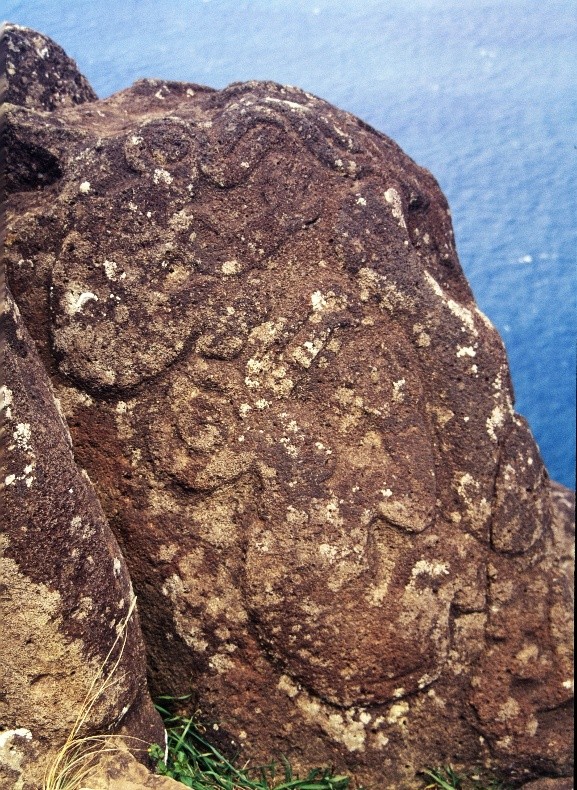
It is easy to sense the past here, to imagine the gathering at Orongo, to smell food steaming among the hot stones in the umus, to hear voices whispering in the dark.
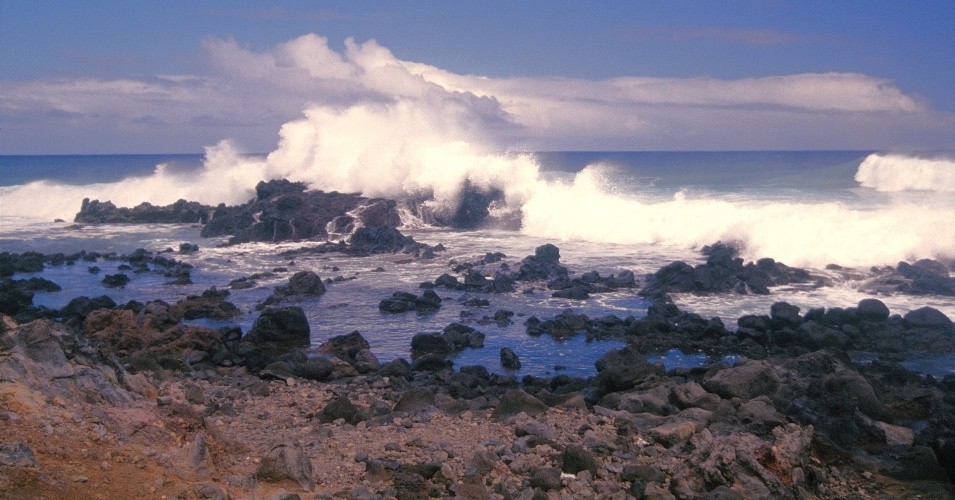
At this southwestern headland of Rapa Nui, with no fringing reef for protection, the deep ocean pounds relentlessly at the island. The erosion is especially obvious here at te Kari Kari, the fragile dip in Rano Kau's seaward rim where erosion has left but a razor thin lip. Far below, a seeping blood-red scar is visible at water's edge. The ocean's destructive fury seems almost incomprehensible in such a beautiful setting.
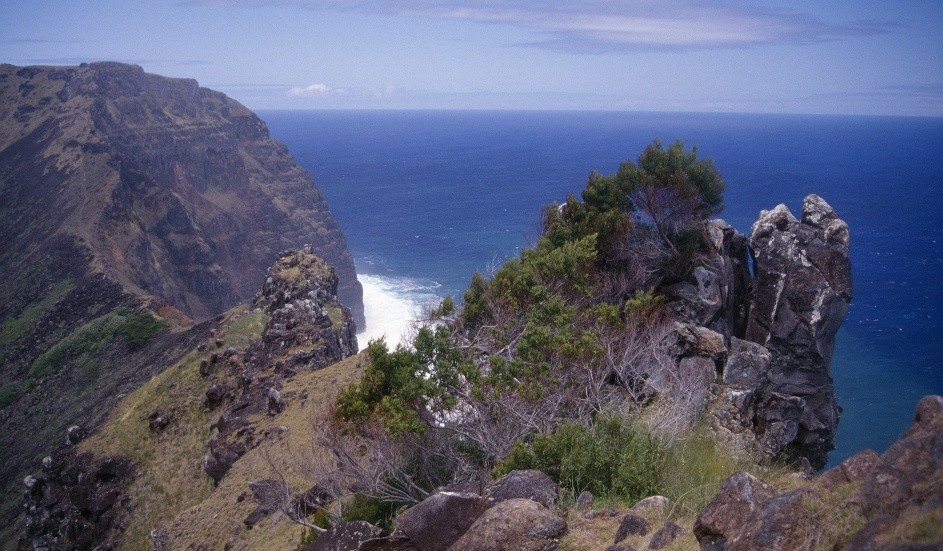
Here at te Kari Kari, jagged shards of basalt hang precariously along the edge of a barely visible path. Turning back, I notice that a luminous crescent moon has silently risen quarter way up above a long tangle of clouds.
After a long peaceful while, I start heading back downhill toward Hanga Roa. Along the way I notice a large prominent stone located in the grassland some distance away off the path. Curious, I head out across the open field, wondering if it might be purposefully placed. When I reach the stone, it is natural, but no less striking. Looking across the grassland, I notice similar stones along hillcrests in the far distance
Topping a rise, a movement catches my eye. I turn to see a stallion a half mile distant, watching, his ears perked, head raised, mane flickering blonde against the dark ocean beyond. For an instant I imagine charging hooves, but the stallion merely watches. I continue, returning to the path.
The path becomes a rutted track winding through a grove of short trees. Up ahead I hear voices and then catch a glimpse of color through the trees. Rounding a bend, I come across three figures, laughing, talking, drinking Crystal, a curious name for the locally popular Chilean beer. They appear to be in their late teens, one is a young woman with a gentle, friendly face. The boys are rascally, but also friendly. I ask directions out of curiosity and the impulse to linger before walking on.
A mile down the path, I hear a dirt bike coming from behind. Moments later the two rascally boys pass by in a blur of dust and noise. The one in back turns, grins, waves. Where is the young woman, I wonder.
Suddenly, a shrill cry, "Keeee-ah", and the sound of wings and wind passing close overhead. The hawk is back. The grove of trees to the right must hold young ones. Again, and again, the hawk dives, then swoops high, crying out in warning, finally retiring to a tree top, watching.
The same one, or another, had similarly swooped and shadowed me across the open fields. Twice I happened to glance back and found the hawk perched on a nearby outcrop, watching.
They are called Chimango Caracara, native to South America, introduced here in the 1930's to control a rat infestation. They are adaptive and smart. They also feed on bird eggs and young offspring. I wonder about the absence of breeding, nesting Sooty Terns on Motu Nui.
From somewhere out across the rolling, rocky grassland, I hear what sounds like Marquesan chanting, breathful, repetitive, "Heh, Heh, Haaah!," reminiscent of the warrior's chants I'd heard in the Marquesas.
I also hear cows. Then, coming up over a rise, a young man appears wearing a faded denim jacket, jeans and boots, tramping through the high grass. A reluctant cow, keeping just ahead, being herded, "Heh, Heh, Haaaah!". They continue through the high grass and up a hill and along and among the black basalt rocks on the hill crest to join a dozen or so other brown and black patterned, short-horned milk cows.
As the cows lumber off, the herder quickly retreats to his dirt bike leaning against a stone wall and takes off in pursuit. He repeats the process over and beyond another and then another hill, methodically moving the cows to greener pastures.
By 6:00 pm, after a long day's wandering, I'm back down in Hanga Roa. The mini-mercado is still open. Inside there is a cooler filled with icy cold bottles of orange Fanta and something that looks like lemonade. On the counter under a little netted tent are three loaves of fresh-baked pound cake. I opt for lemonade and cake. The cake is still warm and crunchy-edged and tasty. The lemonade is carbonated sugar water with Rojo 40 and the familiar Coca-Cola brand label. It is wet even if it isn't the bottled water I needed more. The sun sets late, close to 9:00 pm. There is plenty of time to wander around town a bit, if my spasming back and sore feet will allow.
It's approaching 9:00pm, almost dark now. I'm back at the inn. In the front room I talk with Momma Reina, Cecilia's and Sergio's mother. "Sergio," she tells me, "traveled for learning, and became learned. Cecilia, traveled for experience, and sings all day. Sergio is an important man here," she says, "but he doesn't sing."
Momma Reina seems kind and gentle, and I like her very much. I'm happy that she took the time to be with me, even though we had to stumble through our own pidgin variation of Spanish and English. I wonder if her kindness reflects the general spirit of Rapanui.
I remembered seeing cars whiz by me on the dirt road, thinking to myself, they are shrinking their island, time being relative after all. For the moment at least, I thought, here on this tiny speck of rock surrounded by deep ocean and starry sky, the world still seems immense and mysterious, and time seems lost among the swirling winds.
"It was a good day" I write in my journal that evening. "I saw large stones today in grassy fields, natural formations, dark and rough and gathered on rolling hill tops, clustered and piled high as if to see beyond. I approached one, felt it and passed it and saw a path just beyond it. The path went between another two stones, stones that stood like dominoes in a straight line with other stones further on. Whether natural or purposefully placed, their locations and relationship seemed no less intentional."
I kept imagining those who first journeyed here, those who long ago found themselves alone on this island, a world of blowing grasses and black stone in the endless midst of ocean and stars.
I remembered during my hike across the fields, first feeling a presence and turning for no reason and finding the hawk watching, perched on the black outcrop nearby. He gave a piercing cry, loosed his grip on the rock, spread his wings slightly, then lifted into the wind, soaring high into the sky.
Second Day, 9/30/1998
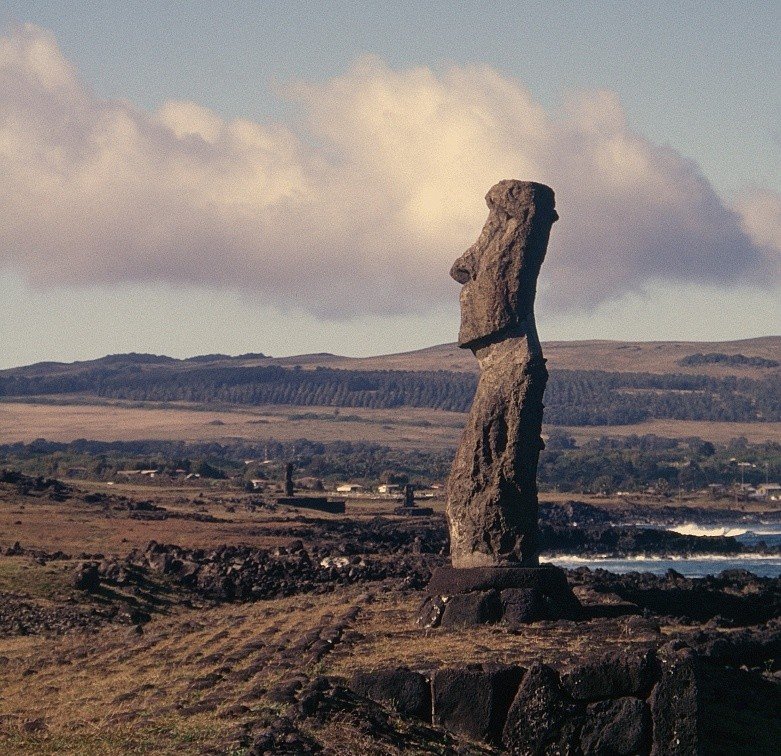
I rented a car and drove out of Hanga Roa through the center of the island, heading to an inland site, Ahu Huri a Urenga, a sole moai, one of the few that is not positioned near the coast. Tall grasses at the base of the ahu shimmer in the morning light. The moai is tall and imposing. No one else is here. Peaceful solitude.
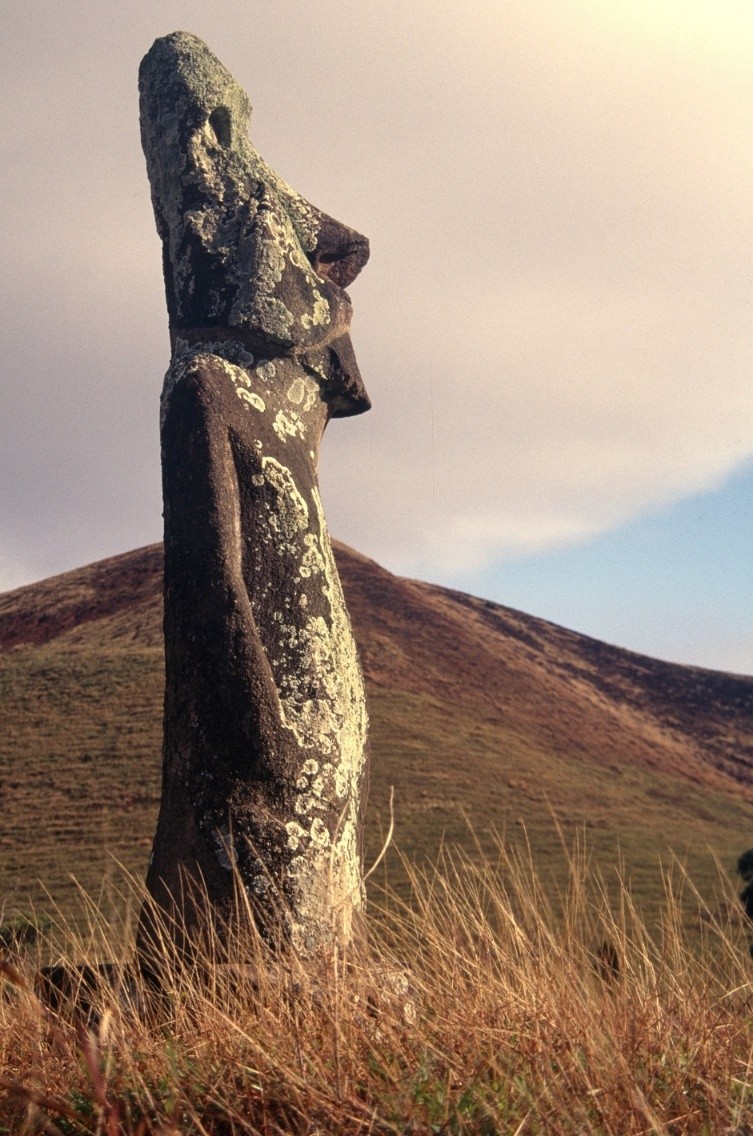
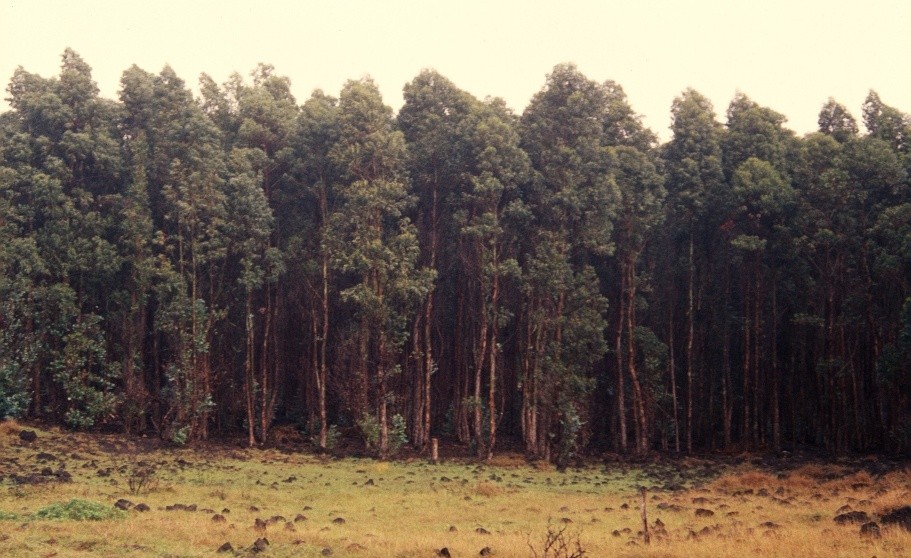
On my way to the far northern shore, I pass through Vaitea, a eucalyptus forest in the middle of the island. Terevaka, the largest and youngest of three volcanoes that form Rapa Nui, rises to my left. Continuing down slope toward the northern coast I arrive at the small crescent sand beach called Anakena where Hotu Matu'a first landed, according to oral tradition.
Evolving science points toward the likelihood of the Marquesas, possibly Hiva Oa, via Mangareva in the Gambier group as origin of those first Polynesian mariners to reach and inhabit Rapa Nui around 1200 AD.
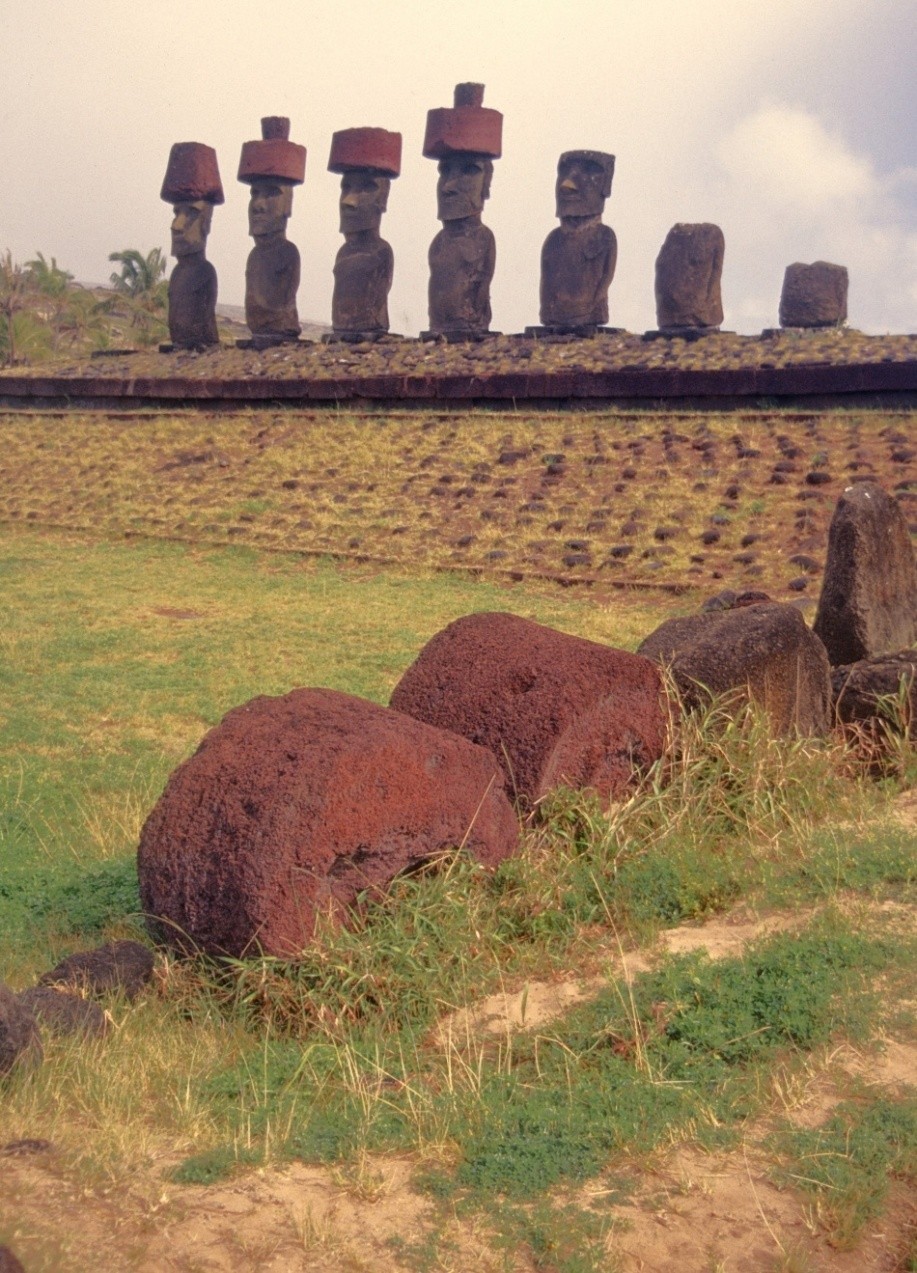
Here at the white sand beach at Anakena there are tall palms, and more hawks nesting and soaring overhead. Inland a short distance are the seven moai of Ahu Nau Nau, once buried in the sand, re-erected in the late 1970's by a group led by Sergio Rapu. Some are whole, two are only partially so.
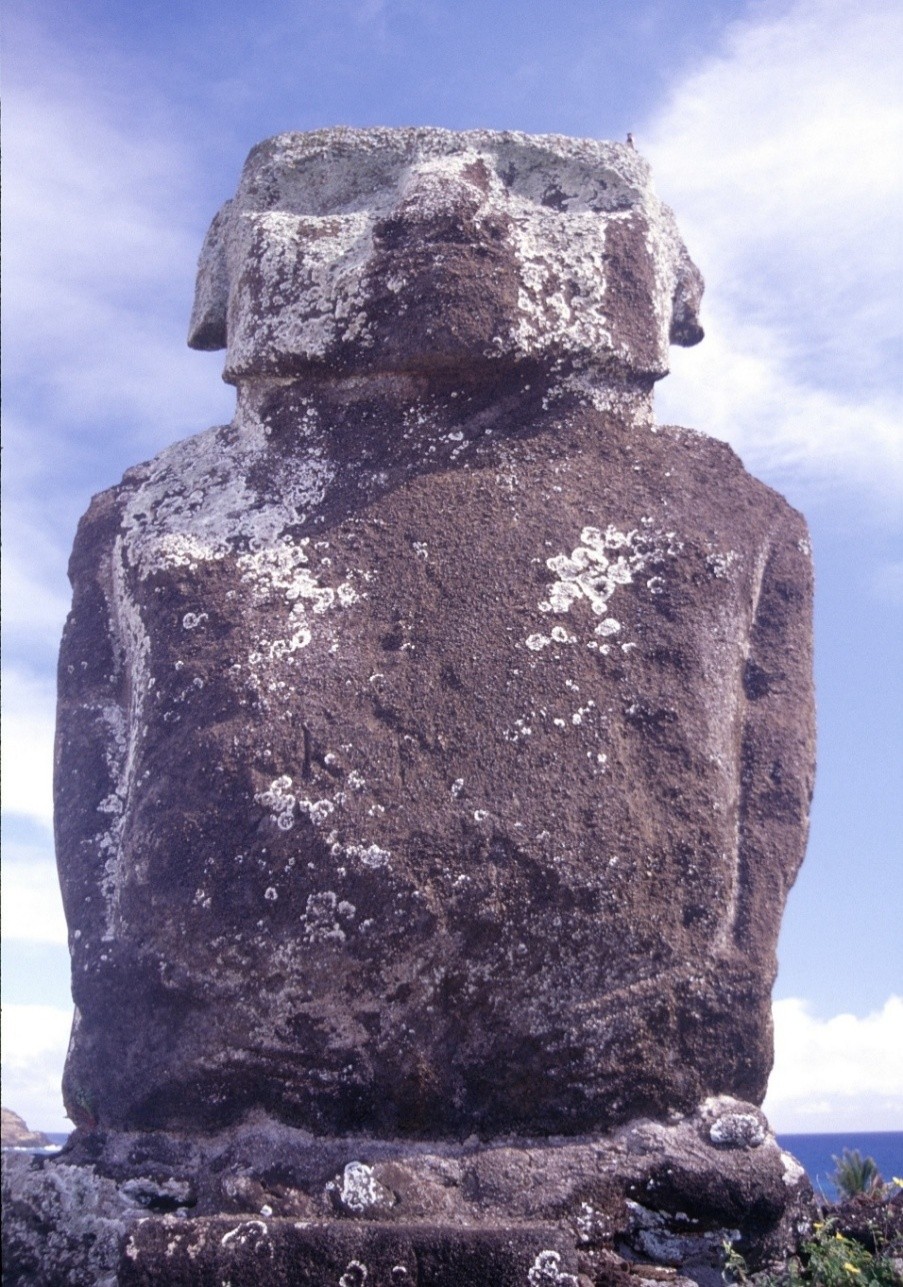
There is also another moai at Anakena, Ahu Ature Huke, older, more compact, set apart on a nearby hill, of a somewhat different style. It was the first moai to be re-erected, by a team led by Norwegian Thor Heyerdahl in 1956.
As I sit in the shade and cool sand to rest and wonder, a small affectionate dark grey cat comes calling, and soon after, a visiting couple from England arrives and waves a cheery hello.
Driving on along the northern coast toward the northeastern headland, a massive fallen moai, Te Pito Kura, comes into view, lying face down close to the rocky shore.
A short distance on, Ahu Kekii also comes into view before the road veers to the south as wind-driven rain squalls pass through and curtains of sunlight shine down on the grassy, rocky plain.
Driving on, I pass slowly alongside an old horse, lying still, ribs showing, eyes glassy, breathing faintly, finally struggling to her feet, shaky, trying so hard to keep alive. The herd grazes nearby, watching and waiting.
Abruptly, around a curve, the fifteen moai of Ahu Tongariki come into view. They are massive, imposing, impossible. I park nearby, and for a while just stare and wonder.
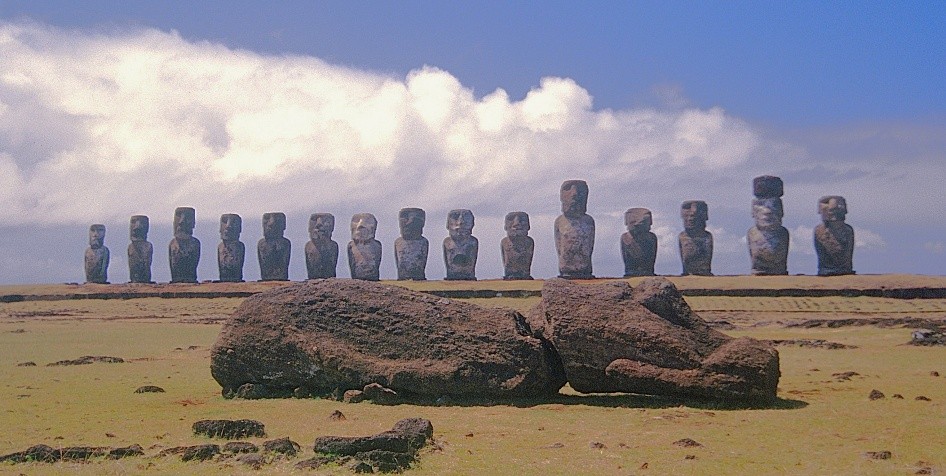
Stunned by the presence of Ahu Tongariki, I finally turn to follow the gaze of the moai inland toward Rano Raraku, the volcanic tuff cone where they were quarried and carved.
Rising majestically from the midst of the stone-strewn plain, sunlight streaming through the partially clouded sky, the face of Rano Raraku glows with warmth and mystery.
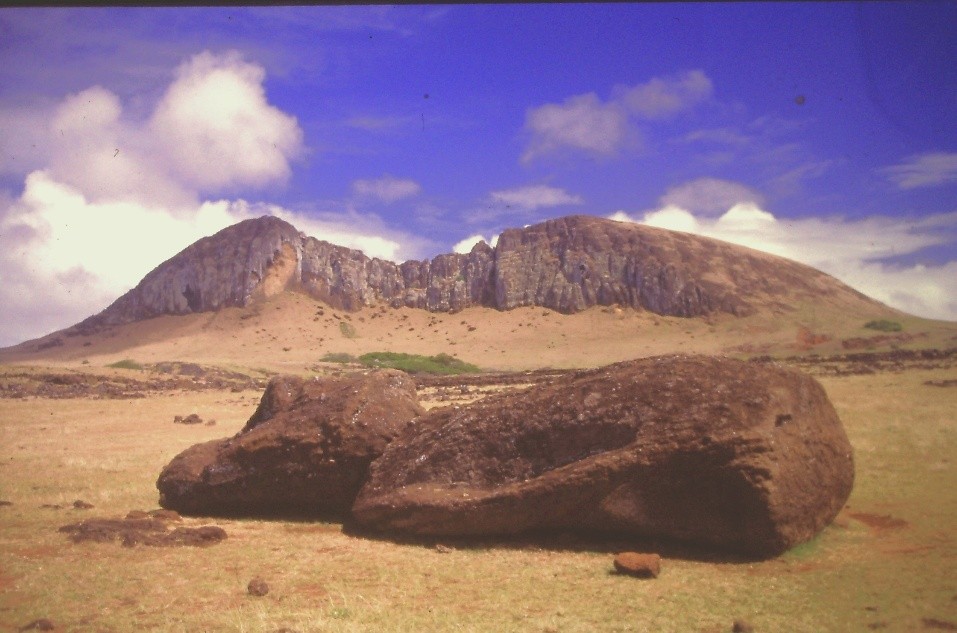
A rutted path winds through the field toward a low stone wall with a Parque Nacional Rapa Nui sign announcing arrival. On a portion of the exterior grassy slope of Rano Raraku, several moai are visible, buried in pits for finishing and further buried with the passage and erosion of time.
Some of the moai seem barely begun, others appear nearly ready to be cut free from their stone keels to slide downslope toward waiting pits. There are multiple works in progress, massive stone monoliths silently waiting for the work to resume. Nearby, the couple from the UK has arrived, are eating their sandwiches on a blanket.
I turn at the sound of footsteps. A booted man in khakis and cap approaches and takes my hand in a strong unrelenting grip. With stony eyes he smiles and says: "No standing on the moai. No pissing on the moai."
As I acknowledge the rules, his grip relaxes and his eyes sparkle with welcome. A small, wizened dog follows behind as he turns and walks back toward his Jeep, waves and is gone.
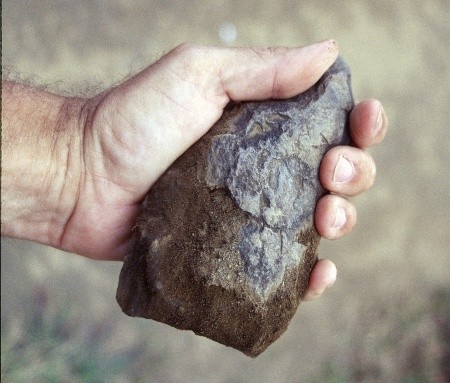
On the ground at my feet, I find what appear to be adze blades, rough-made, designed to be hand-held, functional, disposable and lying broken near partially quarried moai.
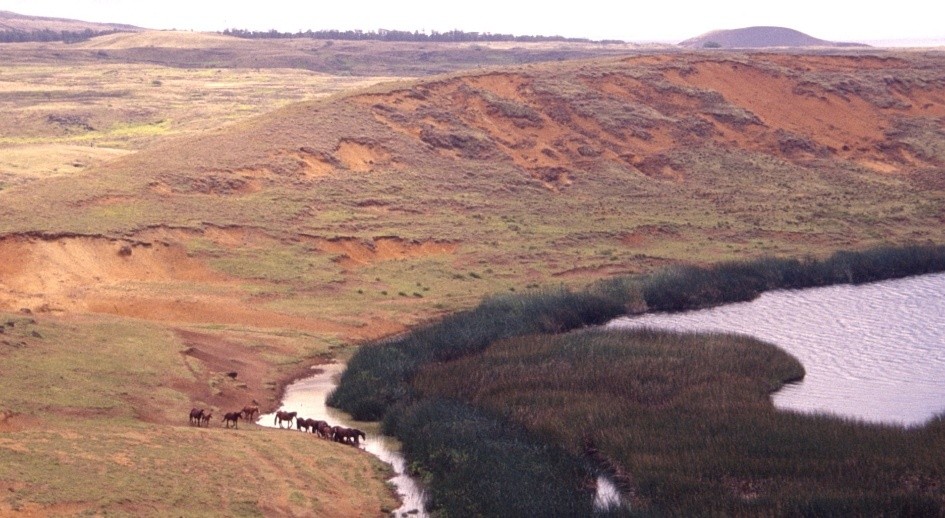
Climbing along the outside face of the crater, gradually climbing uphill, following the route recommended by archaeologist Elaine Jordane in Tahiti, I abruptly crest the rim and find myself staring down into the interior of the crater toward a beautiful small lake edged with marsh grasses. The interior of the crater is grassy and gently sloping with a large number of moai, erect, but partially buried.
Looking toward the opposite, gently sloping rim of the crater, I notice a herd of horses coming over a low rise, trotting down to the lake to drink. I watch until they finally trot back out over the rim and are gone.
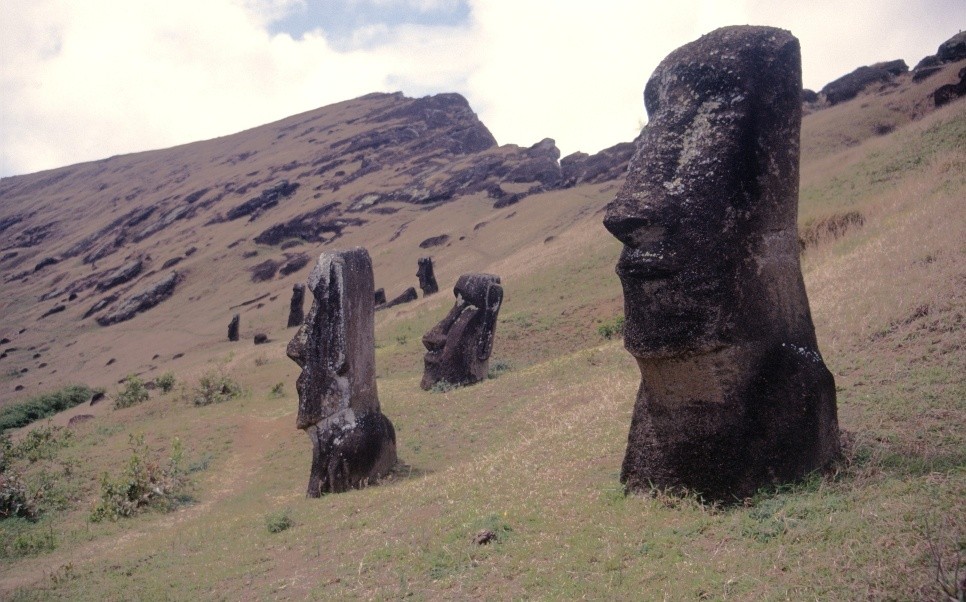
Following the steep narrow foot path back down and around and into the crater, I begin wandering among the moai, unbelieving that I am here among them.
Scientists estimate as many as 300 moai exist here at Rano Raraku. It is staggering to consider, harder still to believe what I am seeing with my own eyes.
I follow the path uphill toward the interior eastern rim. Peering over, my gaze is met by the fifteen moai of Ahu Tongariki, their forms silhouetted against a rain squall fast approaching Poike, the island's eastern headland, with Motu Marotiri lying just off shore. The view is breathtaking.
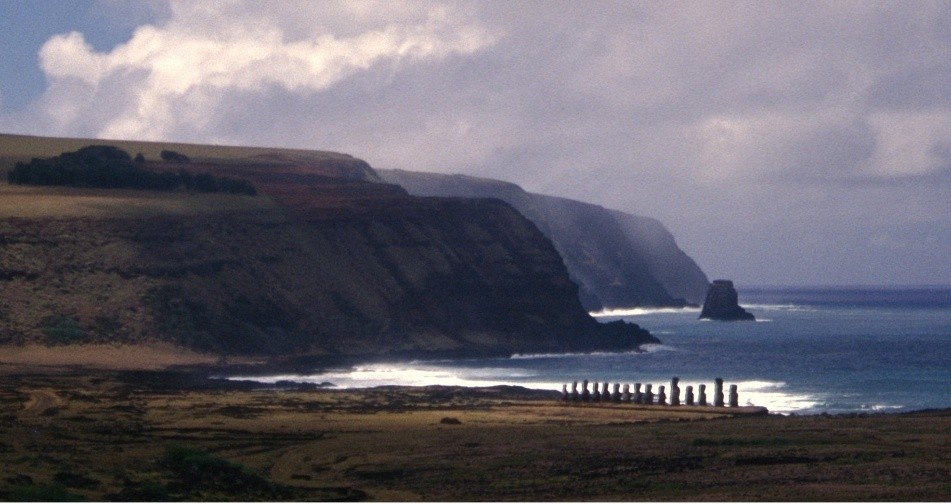
After leaving Rano Raraku and Ahu Tongariki, driving on along the long southeastern coast, I pass several fallen moai lying face down close to shore. Their presence seems somber, and the coast feels strangely empty. Twice I stop to watch and hear and feel the ocean pounding against this desolate, deserted shore.
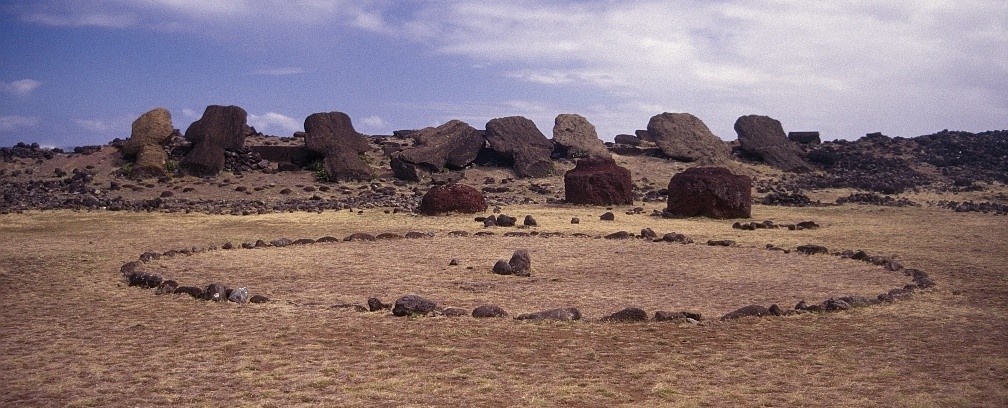
It is almost dark when I finally return to Hanga Roa, turn in my rental car, settle my bill, and head to the Supermercado. Two Chilean soldiers are shopping when I arrive and one of the LanChile flight attendants also enters, recognizes me from our Papeete flight, says "Hola," and smiles.
Tomorrow I will roam around Hanga Roa, visit the museum, buy a souvenir T-shirt if I can find one, take photos around town and find some place to sit and take it all in one last time. I have one more precious day, and two rolls of film left.
Last Day: 10/1/1998, 9:00 am
It's another beautiful, cool and windy morning. I hear Cecilia singing in the back kitchen and the sound of dishes being washed and cupboards opening and closing.
After breakfast I head out to wander. Walking along the waterfront I finally find the museum at the other side of town. It seems to be a good-sized facility, but less a public venue than a research facility, just as it needs to be, I think. There is one small display table of souvenirs and postcards. The receptionist is busy carving a rongorongo board. She doesn't look up.
Continuing along the coast I find a few houses and shops and stop to watch two kids playing marbles in the path.
I find the Post Office, but it has only Chilean stamps today, nothing of Rapa Nui or Oceania. I'd been looking forward to mailing postcards home. I should have settled for the postmark.
During the long leisurely Rapa Nui siesta, stores are closed. Sitting on a small corner park to rest and bide my time, I notice a bronze monument to a Chilean somebody with a descriptive plaque in Spanish.
I know now that this was the Plaza Policarpo Toro, dedicated to the Chilean representative, signer of The Agreement of Wills in 1888.
The plaza name was changed later in 1998 to Plaza Atamu - Toro, commemorating Rapanui leader Atamu Maurata Te Kena, who also signed the agreement alongside Chilean representative Policarpo Toro Hurtado. A second bronze bust Atamu Te Kena has also been installed alongside that of Policarpo Toro's.
The 1888 Agreement of Wills had two versions, one in Spanish, the other in Rapanui-Tahitian. For the Rapanui, the agreement was understood to be an establishment of protectorate status. For the government in Chile, it reflected formal accession of Rapa Nui. The meaning remains in dispute, and the original agreement has yet to be ratified to this day.
As I rest in the plaza grass under shade of a large tree, a young woman passes by, smiles and says "Hola." Two school girls also pass, giggling, chewing gum followed by an older woman in long skirt wearing a sour expression, looking down.
A man arrives at the plaza and lays down to nap in the warm sun and soft grass. A while later another young woman comes to sit in the shade. She and the napping man exchange greetings and talk. I hear the woman say, " diez minutos" and look at my watch; 4:20. It's almost time for the stores to be reopening.
The two school girls pass by again, still chewing gum, heading to the music store in the back of the plaza, calling "Hola, hola, hola" as they disappear through the opened doorway.
An old hound comes over and settles down next to me in the shade as a horseman approaches, shod hooves clop-clopping on the brick-paved avenue. He pauses to talk with the man lounging in the grass as the young woman passes by again, smoking a cigarette now, disappearing into a bar.
Siesta is over, stores are opening. I buy a T-shirt with a graphic silhouette of Ahu Tongariki printed on the front and a book of Rapa Nui history, then head back down toward the waterfront, across from the small fishing boat harbor.
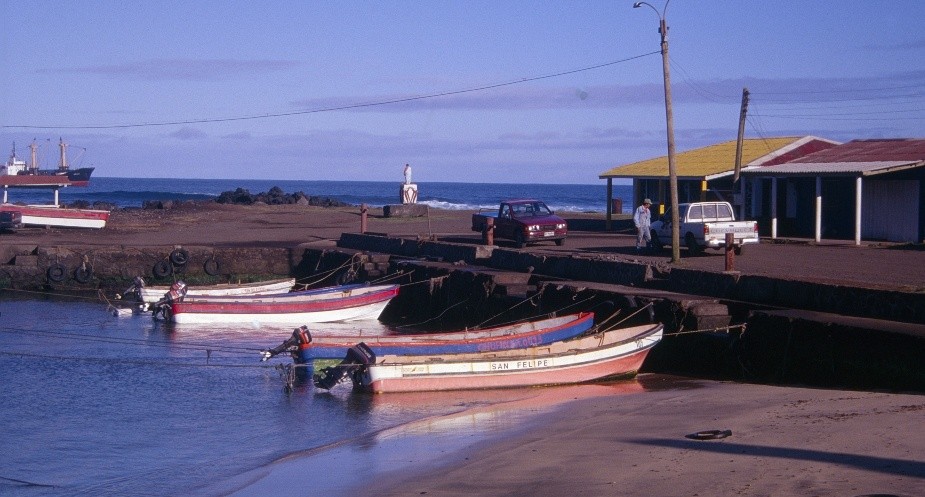
Off shore the supply ship HOTU MATU'A lies quietly at anchor as a cargo-laden Yamaha skiff makes way through the gently rolling swells toward the small wharf across from the soccer field.
Nearby a weathered moai stares inland. In its shadow a woman in sweater and jeans fiddles with the buckle of a stroller, finally lifting a squirming toddler into her arms and down to Earth to join his sister and a watchful, soft-eyed German shepherd to play in the grass.
A whoop and laughter erupts from the soccer field as a goalie stretches short and watches helplessly as the ball whips past into the net. The young mother turns to watch, hands on hips in the late afternoon glow.
All around Hanga Roa, families and friends gather at day’s end as warm cooking smells drift amiably through the quiet.
In the front room at Topara'a Inn, Momma Reina watches a Chilean television news broadcast. Outside the air is becoming cold and gusty as the sun sets down softly into the sea.
A few minutes before time to leave, Cecilia returns to the inn, we settle the bill, $140 for three days. Then Momma Reina laughs, ignoring my outstretched hand, pulling me close for a kiss on the cheek. Then Cecilia drives me over to the airport, pulls up to let me out, then a kiss good bye and I'm on my way.
Waiting inside the tiny airport building for the LanChile aircraft to arrive, I purchase two bandanas printed with rongorongo glyphs from an older woman selling crafts. She smiles and wraps them up nicely for me and I put them in my backpack. A few days later when I unwrap them in Honolulu, I discover that there is only one bandana. I can't help but smile.
Now, nearly 30 years later, looking at Toru's hand-drawn map and recommendations, I realize that I failed to visit close to half of the sites that he had recommended I visit during my three days on the island. I felt some regret in realizing that, but now I realize that what I did have, that the growing number of visitors arriving on the island each year will never again experience, is solitude. To be able to spend precious time alone on Rapa Nui was a gift that I will always treasure.
* * *
All photographs by Michael Weidenbach