
The Sunny 16 Rule: How to Expose Film Without a Light Meter
The Sunny 16 rule lets you expose film correctly without a light meter. In bright sun, set the aperture to f/16 and the shutter speed to 1 over the film speed. With ISO 100 film that is 1/100, or the nearest setting, 1/125, at f/16. From that one starting point you can estimate exposure for almost any daylight scene.
The rule
On a sunny day, at f/16, use a shutter speed of 1/ISO.
"Sunny" means direct sun on the subject with distinct, hard-edged shadows, the sun more than about 30 degrees above the horizon. The rule works because the brightness of direct sunlight on Earth is remarkably constant, around EV 15 at ISO 100.
Adjusting for the light
Keep the shutter at 1/ISO and change the aperture as the light changes. Look at the shadows: their hardness is the best guide.
| Light | Shadows | Aperture at 1/ISO |
|---|---|---|
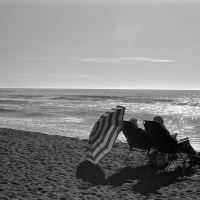
| Snow or sand in bright sun | Dark, sharp | f/22 |
| Bright sun | Sharp edges | f/16 |
| Slight overcast or hazy sun | Soft edges | f/11 |
| Overcast | Barely visible | f/8 |
| Heavy overcast | None | f/5.6 |
| Open shade, or sunset | None | f/4 |
Backlit subjects need about one more stop than the light's row suggests, because you are looking at the shaded side.
Using other shutter speeds
The rule gives you an exposure; equivalent exposures let you change it. With ISO 400 film in bright sun, Sunny 16 gives 1/500 at f/16. These are all the same exposure:
- 1/500 at f/16
- 1/1000 at f/11
- 1/2000 at f/8
- 1/250 at f/22
Fast film in sun can easily exceed a camera's top shutter speed at wide apertures. That is one reason ISO 100 or slower film suits sunny days on older cameras whose fastest speed is 1/500.
Where Sunny 16 doesn't apply
Indoors and at night the light varies too much for a rule of thumb. Some starting points at ISO 400: a bright interior by a window, 1/60 at f/2.8; a lit street at night, 1/30 at f/2; a stage, 1/125 at f/2.8. Bracket these if the shot matters.
Why it works so well with film
Sunny 16 is an estimate, often a stop off. That is well within the exposure latitude of color negative and most black and white films, especially if you err toward more exposure. With slide film, use it as a check on a meter rather than a replacement for one.
Practice
Before your next roll, guess the exposure with Sunny 16, then check it against a meter. After a few days you'll be within a stop most of the time, and you'll notice when a camera's meter is lying.
Terms in this guide
More on exposure and metering
All the guides are on the Learn Film Photography page, and every term is in the glossary. Shot something on film? Share it in the gallery.