

Filters for Black and White Film: Yellow, Orange, Red and Green
Black and white film turns color into tones of gray, and colored filters change which colors become light and which become dark. A filter lightens objects of its own color and darkens objects of its complementary color. With a few filters you can darken skies, separate foliage or smooth skin.
How color filters work on black and white film
A filter passes light of its own color and absorbs others. A red filter passes red light freely, so red objects record strongly on the negative and print light. It blocks blue, so a blue sky records weakly and prints dark. Because filters remove some light, they need extra exposure, expressed as a filter factor.
Filter factors
A filter factor is a multiplier for exposure. A factor of 2 means double the exposure, one stop; 4 means two stops; 8 means three. Through-the-lens meters often compensate on their own, but they can be misled by deep red filters, so many photographers meter without the filter and apply the factor manually.
Common filters and their effects
| Filter | Typical factor | Effect |
|---|---|---|
| Yellow (No. 8, K2) | 2 (1 stop) | Slightly darkens blue sky so clouds stand out, renders tones close to how the eye sees them. A good everyday filter. |
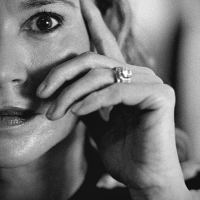
| Orange (No. 21) | 4 (2 stops) | Noticeably darker sky, cuts haze, lightens skin and brick, smooths blemishes. |
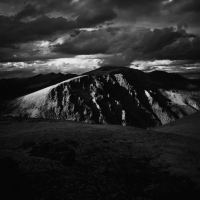
| Red (No. 25) | 8 (3 stops) | Dramatic, near-black skies, strong cloud contrast, cuts distant haze, darkens foliage. Used with infrared film. |
| Deep red (No. 29) | 16 (4 stops) | An even more extreme version of red. |
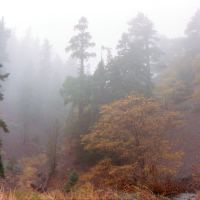
| Yellow-green (No. 11, X1) | 4 (2 stops) | Lightens foliage so leaves separate, mildly darkens sky, natural skin tones outdoors. |
| Green (No. 58) | 6 (about 2.5 stops) | Strongly lightens foliage, darkens red flowers and lips, gives ruddy skin tones in portraits. |
| Blue (No. 47) | 6 (about 2.5 stops) | Increases haze and atmosphere, lightens skies, emphasizes freckles. |
Factors vary slightly by manufacturer and by film, because different films have different red sensitivity. Check the filter maker's figures and your own negatives.
Darkening a blue sky
The effect depends on how blue the sky actually is. A deep blue sky at right angles to the sun darkens dramatically with orange or red; a pale, hazy sky near the horizon barely changes, and an overcast sky not at all, because it isn't blue. Polarizers also darken blue skies, and work on any film.
Filters that work with any film
- Polarizer: darkens blue skies at 90 degrees to the sun and removes reflections from water and glass. Factor about 2.5 to 4.
- Neutral density (ND): reduces light evenly with no color change, for long exposures or wide apertures in sun. An ND 3 (0.9) filter is three stops.
- UV or skylight: cuts ultraviolet haze slightly; mainly used to protect the front element.
Filters for color film
Colored filters for black and white would turn color film the same color, so color film uses correction filters: 85-series amber to use tungsten film in daylight, 80-series blue for daylight film under incandescent light, and mild warming filters such as the 81A to remove a blue cast in shade.
Filters in the darkroom
The same color principle appears when printing: variable contrast paper uses yellow and magenta filters under the enlarger to change contrast.
Terms in this guide
More on cameras, lenses and filters
All the guides are on the Learn Film Photography page, and every term is in the glossary. Shot something on film? Share it in the gallery.