















Why Film Endures: The Analog Resurgence and Where It Goes From Here
A decade ago, the obituary for film photography seemed already written. Kodak had filed for bankruptcy, labs were shuttering by the hundreds, and the cultural assumption was that emulsion belonged in the same drawer as the rotary phone. That assumption turned out to be wrong.
Film didn't just survive the digital era — it found a second life inside it. The global film market is worth somewhere in the low billions of dollars again and growing at a steady mid-single-digit clip, and the people driving that growth aren't aging nostalgists clinging to old habits. A large share of new film shooters are between 18 and 30, picking up cameras older than they are and shooting them with genuine enthusiasm. In 2025 alone, new processing labs opened at a rate of more than 300 locations worldwide — a striking reversal of two decades of closures, and the r/analog community on Reddit has grown past 1.5 million members.
So the interesting question is no longer whether film is back. It's why it came back, and where a craft this stubborn is headed next.
Film in the Age of Digital
The case against film is easy to make on paper. It's slower, more expensive per frame, and you don't see the result until later. Every one of those drawbacks is precisely the point.
Digital photography removed friction so thoroughly that it changed what taking a picture means. When frames are free and infinite, the natural instinct is to shoot first and think later — fire off forty exposures and sort it out on a screen. Film inverts that. A roll of 35mm gives you 36 frames; a roll of 120 in 6x7 gives you ten. When each frame costs something, you slow down. You meter. You wait for the light. You commit. A meaningful slice of film shooters describe the practice as a kind of digital detox — a deliberate counter to filter fatigue and the endless scroll, and that intentionality is most of the appeal.
There's also the matter of the image itself. Film renders color, grain, and tonal transition in a way that digital sensors approximate but rarely replicate outright. Highlights roll off gently instead of clipping to white. Color negative film has remarkable latitude in the highlights. Grain reads as texture rather than noise. None of this makes film "better" than digital in any absolute sense — it makes it different, and that difference is a creative choice worth having.
And in an era where AI can generate a photorealistic image of something that never happened, the physical, chemical fact of film carries a new kind of weight. A negative is a record that light actually struck a surface at a moment in time. That authenticity is becoming part of film's value proposition, not just its romance.
Where the Detail Lives: Medium and Large Format
The resurgence often gets framed around 35mm point-and-shoots and the Instagram look. But the deeper you go into film, the more you run into the thing that no full-frame digital camera can easily match: sheer negative size.
This is the part that surprises people coming from digital, where "bigger sensor" tops out at a few centimeters. Film has no such ceiling. The principle is simple — a larger piece of film captures the same scene across far more physical area, which means proportionally more detail, smoother tonal gradation, and the ability to enlarge enormously without the image falling apart.
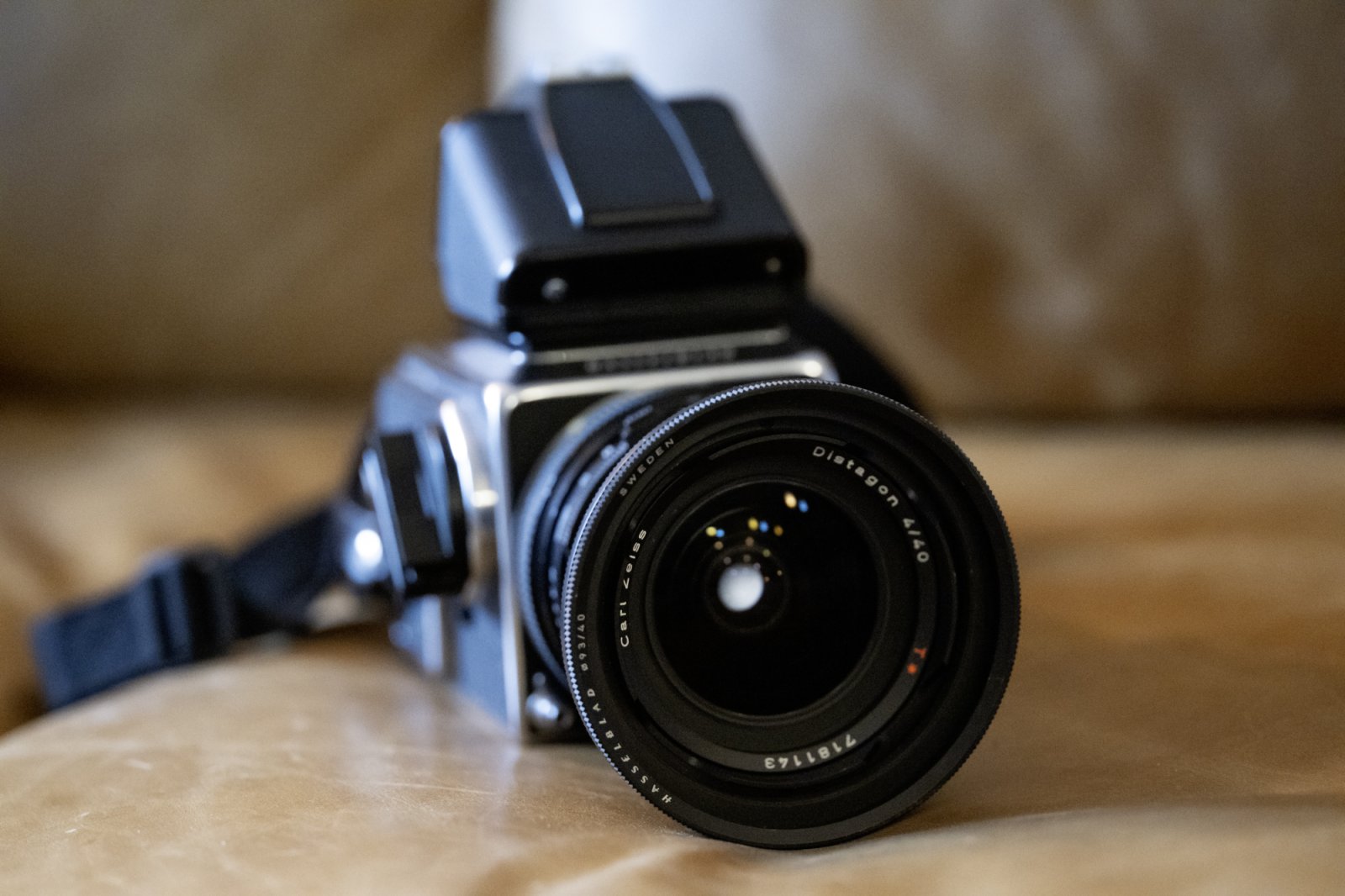
Medium format (shot on 120 roll film) is the first real step up. A 6x7 negative is roughly four-and-a-half times the area of a 35mm frame. That extra real estate shows up immediately in print: finer apparent grain, richer tonality, and a three-dimensional rendering that's hard to describe and obvious once you've seen it. Cameras like the Hasselblad 500-series, the Mamiya RB67, and the Pentax 67 became icons for exactly this reason. Medium format is where many photographers discover that "more detail" isn't only about resolution — it's about quality of tone.
4x5 large format moves into a different league entirely. A single 4x5 sheet has an image area of roughly thirteen to fifteen times that of a 35mm frame. Beyond the raw detail, the view camera itself unlocks something no smaller format offers: movements. Tilting and shifting the lens and film planes lets you control where focus falls and correct converging verticals optically, in-camera — the reason large format remains the standard for serious architectural and landscape work. It is deliberate, tripod-bound, head-under-the-darkcloth photography, and the negatives reward every bit of that patience.
8x10 is the deep end. A sheet is four times the area of 4x5 and somewhere around fifty times that of a 35mm frame. At this size you can make a contact print — laying the negative directly on the paper, no enlargement at all — and the tonal smoothness of a good 8x10 contact print is something photographers chase for a lifetime. This is the format Edward Weston and Ansel Adams built their reputations on, and the look has never really been bettered. It is slow, heavy, expensive, and gloriously uncompromising.
The trade-off is honest: every step up in format costs you portability, speed, and money per frame. But if the goal is the maximum amount of information and tonal richness a single exposure can hold, film still owns territory that digital can only reach by stitching dozens of frames together.
Where It's Going
The most encouraging signal isn't that old cameras are being bought and sold — it's that the supply chain is investing in the future again.
For the first time in roughly two decades, a major manufacturer built a brand-new film camera: Ricoh launched the half-frame Pentax 17 in summer 2024, its first new film camera in nearly twenty years, deliberately designed for a smartphone generation. It went on to land on Time's list of the best inventions of 2025, and initial demand outstripped what the company could produce — a problem no one expected a film camera to have in this decade.
The film itself is being reinvented too. Harman introduced Phoenix, a brand-new color emulsion, in 2023 and shipped a revised Version II in 2025; CineStill launched its 400D stock; ORWO brought back color negative film under the Wolfen name; and Ilford expanded its Kentmere line into 120. Kodak's film sales jumped around 20% in 2024 and the company has been expanding rather than retreating, with classic stocks like Portra 400 and Tri-X seeing the steepest demand growth. New emulsions are genuinely hard to formulate and manufacture, so each new release is a real vote of confidence.
That said, an honest forecast has to name the headwinds. Film and processing have gotten markedly more expensive, and availability and lab turnaround times are real frustrations for a sizable chunk of shooters. Manufacturing is concentrated in a small number of companies — lose one and the ecosystem feels it. The fairest comparison is probably vinyl records: not a fad that spikes and collapses, but a format that found a durable, profitable niche by offering something the dominant technology can't. The underlying drivers here — generational adoption, a cultural pull toward slower and more tangible making, and premium positioning that's actually profitable — point to staying power rather than a passing trend.
Film will never again be the default way the world makes photographs. It doesn't need to be. It has become something arguably more interesting: a deliberate choice, a craft, and a medium that still does things nothing else can. For anyone holding a loaded camera right now, that's a good place to be.